
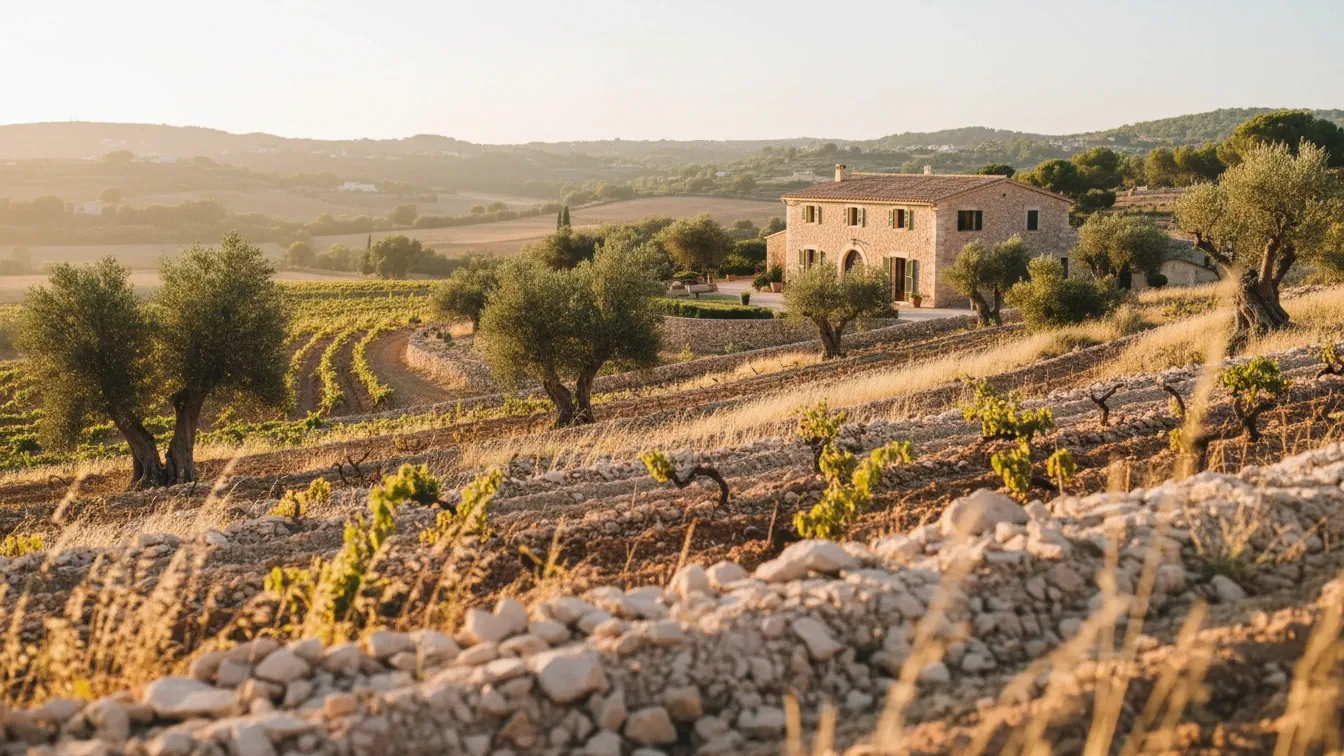
Biodynamic wine begins with a living-farm approach: the vineyard, soil, plants, animals, and people function as one connected system. Demeter certification verifies that this idea becomes a documented agricultural and processing practice, not merely a poetic label. The result is wine shaped by strict ecological rules, careful observation, and the character of its place. For Montesion Wine Estate, this approach connects biodynamic practice with Mallorca’s distinctive landscape.
In 2026, wine drinkers face a crowded vocabulary: organic, natural, regenerative, biodynamic, and sustainable. These terms overlap, but they do not mean the same thing. A bottle may come from organic grapes without meeting biodynamic standards, while a biodynamic farm still needs separate approval for certified wine processing. That distinction matters in Mallorca, where hot summers, limited rainfall, limestone soils, and strong coastal winds test every vineyard decision. This guide explains the principles behind biodynamic viticulture, the practical meaning of Demeter certification, and the measurable evidence comparing organic, biodynamic, and conventional systems.
Learning objectives
By the end of this guide, an informed beginner should be able to:
- Define biodynamic wine and explain its relationship with organic farming in 20 minutes.
- Identify the main agricultural requirements associated with Demeter certification.
- Compare organic wine vs biodynamic production using evidence rather than marketing language.
- Explain how soil cover, compost, biodiversity, and water management affect a Mediterranean vineyard.
- Distinguish certified biodynamic grapes from wine processed under a certified biodynamic standard.
- Evaluate a wine label and ask precise questions about farming, certification, and cellar practices.
- Complete the self-assessment and glossary review after reading the full guide.
No previous wine knowledge is required. You only need a willingness to separate verifiable practices from attractive but vague claims.
What does biodynamic wine actually mean?
Biodynamic wine comes from grapes grown through biodynamic agriculture and processed according to the applicable biodynamic wine standard. The farming system treats the entire estate as a living organism rather than as a field that simply supplies grapes. Soil, vines, hedgerows, animals, water, insects, and human work form a connected cycle.
The concept developed from agricultural lectures given by Rudolf Steiner in 1924. Modern biodynamic farming includes ideas that resemble regenerative agriculture, such as composting, biodiversity, closed nutrient cycles, and reduced dependence on external inputs. It also uses specific preparations made from plants, minerals, and composted animal manure. Those preparations form part of the method, although their exact effects remain an area of scientific investigation.
A useful comparison is the difference between a recipe and a complete kitchen. Organic farming supplies a defined set of restrictions and permissions. Biodynamic farming adds a broader management philosophy, prescribed preparations, biodiversity expectations, and closer attention to the farm as an integrated system. Neither approach automatically guarantees a superior-tasting wine. Vineyard site, grape variety, vintage, cellar choices, and tasting conditions still matter.
Mini-exercise: Write a one-sentence definition without using the words “natural,” “pure,” or “authentic.” A strong answer should mention certified farming, ecological integration, and regulated processing.
How does Demeter certification work from soil to bottle?
Demeter certification provides the clearest formal test for biodynamic claims. The farm must meet a demanding standard, undergo inspection, and maintain records that demonstrate compliance. Certification applies to the agricultural operation as a whole rather than allowing a convenient biodynamic corner beside conventionally managed land.
The farm standard requires organic management as a foundation. Synthetic herbicides, pesticides, fungicides, and chemical fertilizers are prohibited under the relevant rules. Biodynamic certification then adds requirements concerning preparations, biodiversity, soil fertility, farm integration, and the reduction of imported inputs. Demeter materials describe a minimum biodiversity set-aside of 10% of the farm’s total area, although exact requirements depend on the applicable standard and certification jurisdiction.
Certification also has a second stage. Grapes from a certified farm do not automatically produce a wine that may use every biodynamic designation. The winery must comply with the relevant processing standard, which limits manipulation and regulates permitted additions. The demeter.net standards distinguish between categories such as certified biodynamic wine and wine made from biodynamic grapes.
The distinction protects consumers from a common misunderstanding. A vineyard can hold agricultural certification while the finished wine carries a narrower claim because its cellar practices do not meet the highest processing category. Label wording therefore deserves careful attention.
| Stage | What is assessed | Why it matters |
|---|---|---|
| Farm conversion | Previous management and transition period | Soil and biological systems need time to change |
| Annual inspection | Records, inputs, land use, and preparations | Certification depends on evidence, not intention |
| Grape production | Whole-farm biodynamic compliance | Partial certification can mislead consumers |
| Winery processing | Additions, techniques, and cellar records | Certified grapes do not guarantee certified wine |
| Labelling | Approved wording and trademark use | The claim must match the certification category |
Mini-exercise: When you see “made with biodynamic grapes,” ask whether the wine itself meets the full processing standard. The wording may describe certified fruit without claiming complete biodynamic wine certification.
What happens in biodynamic viticulture during a Mediterranean year?
Biodynamic viticulture turns ecological principles into repeated seasonal decisions. In Mallorca, those decisions begin with water. A vineyard must cope with intense summer heat, limited rainfall, and rapid evaporation, so soil cover and organic matter become practical tools rather than abstract ideals.
Cover crops can protect the soil surface, improve habitat, and reduce erosion after heavy rain. Compost returns nutrients and organic matter to the ground. Hedgerows, trees, uncultivated margins, and flowering plants provide shelter and food for insects. Animals may contribute manure, grazing, or another link in the farm’s nutrient cycle. These features make the estate more than a series of vine rows.
Biodynamic preparations are applied in small quantities according to defined methods. Preparation 500 traditionally uses fermented cow manure, while preparation 501 uses silica. Other preparations involve plants such as yarrow, chamomile, nettle, oak bark, dandelion, and valerian. Farmers use them within a wider management program, not as substitutes for observation, canopy work, disease monitoring, or sound soil management.
Research does not support every biodynamic claim equally. A 2023 field study assessed preparations 500 and 501 alongside vine physiology, soil properties, and the soil microbiome over several years, showing why long-term, replicated trials matter. The scientific question is not whether a farm follows a meaningful philosophy. It is which practices produce measurable changes under specific conditions.
Example: A grower in Porreres may use permanent or seasonal cover, compost, careful canopy management, and biodiversity corridors to protect soil moisture. The same grower still needs to monitor mildew risk after rain and manage vine balance through precise field work.
Mini-exercise: Name two practices that directly address Mallorca’s dry summers. Soil cover and increased organic matter are strong answers because both can support water retention and biological activity.
Is organic wine different from biodynamic wine?
The question “organic wine vs biodynamic” has a straightforward starting point: biodynamic agriculture includes organic requirements but goes further. Organic standards focus mainly on permitted and prohibited substances, while biodynamic standards also organize the farm around ecological integration, preparations, biodiversity, and reduced external dependence.
That does not make organic wine inferior. Certified organic viticulture can eliminate synthetic herbicides and pesticides, improve soil management, and support biodiversity. The quality of a particular organic wine still depends on the grower’s skill and the site. Likewise, biodynamic certification does not remove the need for careful harvesting, hygienic cellars, balanced fermentation, and thoughtful maturation.
A systematic quantitative review in the American Journal of Enology and Viticulture examined representative studies comparing conventional, organic, and biodynamic management. Seventeen of 24 studies found a clear increase in biodiversity under organic viticulture. The review also reported lower average growth and yield in organic and biodynamic systems than in conventional vineyards, while finding no overall difference in berry composition or wine quality across management systems. These findings are useful because they replace simple superiority claims with a more nuanced picture.
| Question | Organic farming | Biodynamic farming |
|---|---|---|
| Synthetic inputs | Restricted or prohibited under the relevant regulation | Restricted or prohibited, with additional requirements |
| Biodiversity | Encouraged and often improved through management | A formal part of the whole-farm system |
| Compost | Permitted and widely used | Central to farm fertility and preparations |
| Preparations | Not generally required | Required under biodynamic standards |
| External inputs | Some approved organic inputs may be allowed | Stronger emphasis on self-sufficiency |
| Wine processing | Governed by organic wine rules | Governed by a biodynamic processing standard for certified claims |
Mini-exercise: Complete this sentence: “Organic certification mainly tells me what inputs are restricted; biodynamic certification also tells me…” The best completion mentions whole-farm integration, preparations, biodiversity, and processing requirements.
What does the science say about biodiversity, yield, and wine quality?
Science-based discussion requires separating three questions. First, does management change the vineyard ecosystem? Second, does it change yield or vine growth? Third, does it change the composition and sensory quality of the wine? Evidence may answer these questions differently.
Organic and biodynamic systems often use cover crops, compost, and fewer herbicides. Those practices can increase biological activity and create habitat for multiple trophic levels. However, competition for water can reduce vine growth in dry environments. The systematic review cited above reported 21% lower growth and 18% lower yield for organic and biodynamic treatments compared with conventional management in the studies it evaluated. That average does not predict every vineyard or every year.
Lower yield can arise from several factors, including soil moisture, disease pressure, vine age, pruning, and local climate. A smaller crop does not automatically create better wine. Concentration depends on ripeness, vine balance, berry size, extraction, fermentation, and many other variables. Conversely, a productive vineyard can make excellent wine when the grower manages fruit maturity and plant health well.
The review found no overall difference in berry composition, juice quality, or wine quality among management systems. That result should not be read as a dismissal of biodynamic farming. It means that farming system alone cannot guarantee sensory superiority. Biodiversity, resilience, soil stewardship, and transparent certification may be the strongest reasons to choose a biodynamic estate, while taste remains a vintage-specific experience.
Mini-exercise: Separate the following claims into “measurable farming outcome” or “sensory promise”: “more insect habitat,” “lower average yield,” “better expression in the glass,” and “greater soil biological activity.” The first, second, and fourth are suitable for measurement; the third requires controlled tasting evidence.
How can indigenous grapes reveal the character of Mallorca?
A biodynamic vineyard does not erase terroir. Instead, it gives the grower a framework for observing how soil, climate, varieties, and farming interact. Mallorca’s indigenous Callet and Prensal Blanc offer a useful lens because local varieties carry a long relationship with the island’s climate and agricultural history.
Callet can show ripe red and dark fruit, earthy tones, moderate tannin, and balanced acidity when harvested at the right point. Prensal Blanc can bring freshness and a distinctive island identity to white blends. Viognier, although not indigenous to Mallorca, demonstrates how a variety responds to the same Mediterranean conditions through floral and exotic fruit aromas.
This is where a bottle can become a practical lesson rather than a marketing symbol. For example, Montesión Selección Privada 2021 presents a full-bodied, velvety profile with intense color, bold flavor, and firm tannins. Those sensory details do not prove biodynamic certification by themselves. They show how a finished wine can carry texture, ripeness, and structure while the underlying farming and cellar decisions remain part of the larger story.
The unexpected comparison is with an olive grove. A vineyard and an olive orchard both depend on living soil, flowering margins, water management, and long-term observation. Neither becomes ecologically sound through a single treatment. Their resilience comes from repeated decisions across many seasons, followed by honest records and independent inspection.
Mini-exercise: Taste any red wine after noting its variety, vintage, alcohol, acidity, tannin, and finish. Then ask which observations are sensory and which would require farming or cellar records. This separates what your palate can detect from what certification verifies.
How should you read a biodynamic wine label?
A reliable label answers less than many consumers expect. It may identify the certification mark, the wine category, the origin, the vintage, and the producer. It usually cannot tell you how much biodiversity exists on the farm, which preparations were used, or whether the wine spent time in stainless steel, oak, stoneware, or amphora.
Start with the exact wording. “Biodynamic wine” and “wine made from biodynamic grapes” are not interchangeable claims. Then check whether the certification applies to the farm, the winery, or both. A producer should be able to explain the certification body, the applicable standard, and the relationship between grape production and processing.
Next, consider the broader evidence. Look for transparent information about spontaneous or inoculated fermentation, permitted cellar additions, vineyard location, harvest method, and aging vessel. These details do not prove biodynamic farming, but they help you understand how the wine was made. Avoid assuming that terms such as “natural,” “clean,” or “living” have one universal legal meaning.
A practical checklist can keep the process simple:
- Identify the exact biodynamic claim on the label.
- Confirm which certification body stands behind that claim.
- Check whether the farm and wine processing both meet the relevant standard.
- Note the grape variety, vintage, origin, and stated cellar practices.
- Treat sensory impressions as evidence of the wine, not proof of the farming system.
- Ask for records or technical information when a claim remains unclear.
Mini-exercise: Imagine a label says “organic grapes, biodynamic-inspired cellar.” Does that equal certified biodynamic wine? No. The phrase may describe an intention, but it does not establish Demeter certification.
A practical learning plan for tasting and vineyard study
The best way to understand biodynamic wine is to combine reading, observation, and tasting. A short study plan can turn technical language into experience without treating one bottle as scientific proof. The sequence below suits a beginner with an intermediate interest in wine.
Begin with one certified wine and record its producer, region, variety, vintage, certification wording, and alcohol level. Taste it at the recommended temperature. Note aroma, acidity, tannin, body, texture, finish, and any change after 20 minutes. Avoid writing “biodynamic taste,” because no single flavor defines the farming system.
Then compare the wine with another bottle made from the same variety or a similar climate. Keep the tasting conditions as equal as possible. Finally, read the producer’s technical information and compare what you sensed with what the winery documents. This exercise teaches a valuable discipline: the palate describes outcomes, while certification verifies processes.
Use these study resources for further investigation:
- The ajevonline.org systematic review of organic and biodynamic viticulture.
- The oeno-one.eu study of preparations 500 and 501, vine physiology, soil properties, and the soil microbiome.
- The demeter-usa.org wine FAQ covering farm and processing distinctions.
- The montesionwineestate.com explainer on Demeter certification and Mediterranean vineyard conditions.
Mini-exercise: Prepare a five-line tasting note, then a five-line farming note. Keep the two sections separate. That simple division prevents unsupported claims about what your palate can prove.
Self-assessment, glossary, and key takeaways
Use this short self-assessment after completing the modules. Each answer should be explainable in plain English, without relying on slogans.
- Does organic certification automatically mean a wine is biodynamic?
- Why can certified biodynamic grapes still produce a wine with a narrower label claim?
- What is one reason cover crops matter in Mallorca?
- Does lower average yield prove that a wine will taste better?
- What does the 10% biodiversity reference describe?
Answers:
- No. Biodynamic standards add requirements beyond organic farming, including preparations, whole-farm integration, and specific certification conditions.
- The winery must also meet the relevant biodynamic processing standard before using the broadest certified wine designation.
- Cover crops can protect soil, support biodiversity, reduce erosion, and help manage organic matter, although they may compete for water.
- No. Yield and sensory quality are related in complex ways, and lower yield does not guarantee better wine.
- It refers to a biodynamic farm requirement for maintaining a portion of total land as biodiversity habitat under the applicable standard.
Glossary
- Biodynamic agriculture: A whole-farm system combining organic restrictions, ecological integration, preparations, and close observation.
- Biodynamic preparation: A regulated material made from plants, minerals, or composted manure and applied in small quantities.
- Biodiversity set-aside: Land maintained for habitat rather than direct crop production.
- Callet: A red grape variety strongly associated with Mallorca.
- Cover crop: Plants grown between or beneath vine rows to protect and enrich soil.
- Demeter certification: Independent certification for farms and processing operations meeting biodynamic standards.
- Organic farming: Regulated agriculture that restricts or prohibits specified synthetic inputs.
- Prensal Blanc: A white grape variety native to Mallorca and used in local wines.
- Regenerative agriculture: A broad approach focused on improving soil, biodiversity, and ecological function over time.
- Spontaneous fermentation: Fermentation that begins with naturally present microorganisms rather than an added commercial culture.
- Terroir: The interaction of place, climate, soil, variety, and human decisions in wine.
- Whole-farm system: Management that treats the complete agricultural estate as one connected organism.
The living system behind the label
Biodynamic wine is best understood as a certified relationship between farming, ecology, and cellar practice. Demeter certification adds accountability, but it does not turn every bottle into a scientific experiment or guarantee a preferred flavor. The strongest evidence supports specific outcomes: organic management can increase biodiversity, soil practices influence biological activity, and dry climates make water management decisive.
For a Demeter-certified estate in Mallorca, the principle becomes concrete through local varieties, Mediterranean heat, seasonal water pressure, and long-term soil care. Indigenous Callet and Prensal Blanc connect the discussion to place, while Viognier shows how a different variety can adapt to the same conditions. That combination of measurable practice and regional character is what gives biodynamic wine its most credible appeal. Montesion Wine Estate reflects this connection between certification, island conditions, and careful stewardship.
Preguntas frecuentes
Is biodynamic wine the same as organic wine?
Biodynamic wine is not simply another name for organic wine. Biodynamic farming includes organic restrictions but adds whole-farm integration, biodiversity requirements, specific preparations, and additional certification conditions. Organic certification can therefore be valid without biodynamic certification, while a biodynamic farm must generally satisfy organic foundations first.
What does Demeter certification guarantee?
Demeter certification verifies that a farm and, where applicable, its winery meet defined biodynamic standards through inspection and documentation. It addresses farming methods, inputs, biodiversity, preparations, and processing requirements. It does not guarantee that every certified wine will taste better, because flavor also depends on variety, vintage, site, harvest timing, and winemaking decisions.
Are biodynamic wines healthier than conventional wines?
Certification does not establish that biodynamic wine provides a universal health advantage over conventional wine. Biodynamic farming restricts certain agricultural inputs, and certified processing controls permitted cellar practices, but wine remains an alcoholic beverage. Consumers should evaluate certification as information about production methods, not as a medical claim.
Does biodynamic farming improve wine quality?
Biodynamic farming can support biodiversity, soil biological activity, and a more integrated farm ecosystem, but research does not show a universal sensory advantage. A systematic review found no overall difference in berry composition or wine quality across organic, biodynamic, and conventional systems. The quality of an individual wine still depends on the site, grape variety, vintage, and skill of the producer.
