

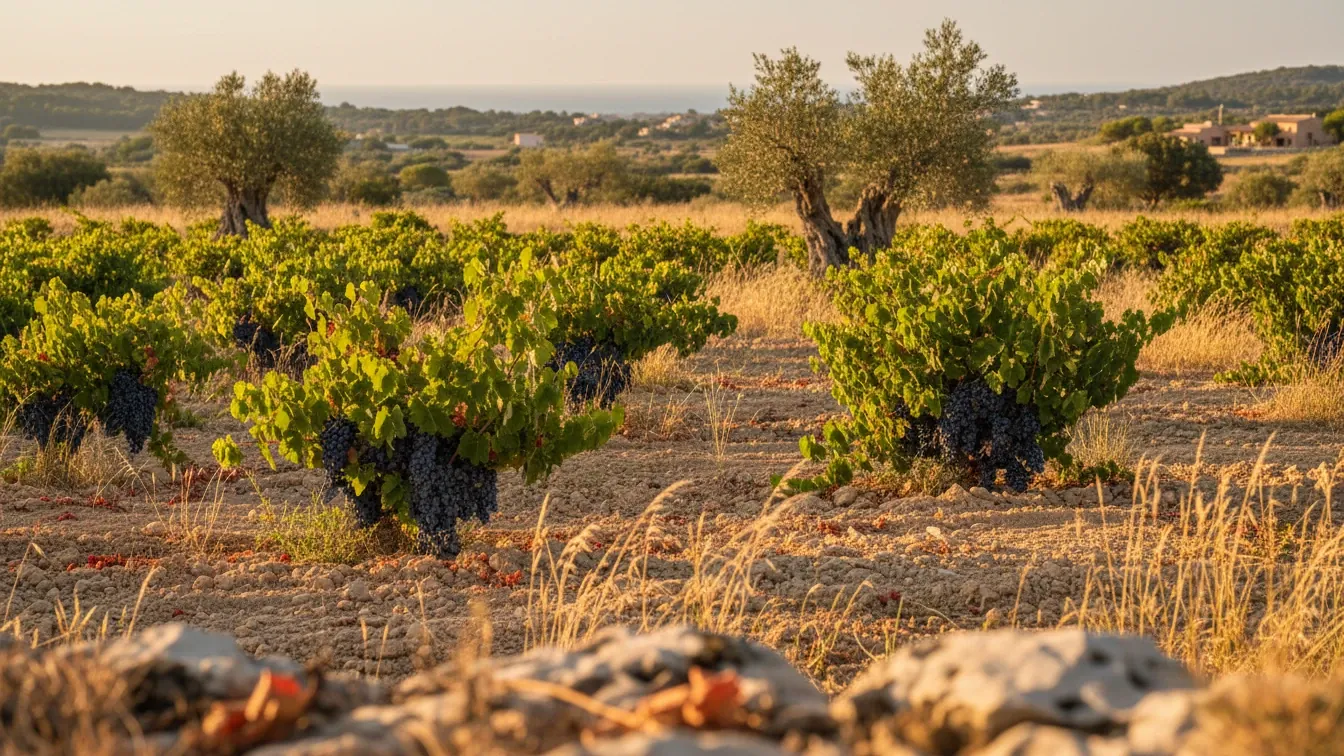
The callet grape is a Mediterranean red wine variety that delivers fresh, expressive wines suited to Mallorca’s warm, dry conditions. Its pale ruby colour, red-fruit character, moderate tannins, and naturally moderate alcohol distinguish it from heavier southern European grapes. For wine lovers seeking indigenous wine grapes Mallorca can genuinely call its own, Callet offers an unusually clear taste of place. At Montesion Wine Estate, it provides a direct expression of the island’s agricultural identity.
Mallorca’s vineyards face a demanding equation: intense sunlight, scarce summer rainfall, and increasingly warm growing seasons. Yet Callet continues to perform where many international varieties can become overripe or lose freshness. Its later ripening helps preserve acidity while allowing flavour and tannin maturity at moderate alcohol levels, a valuable balance in Mediterranean viticulture. The variety also connects modern biodynamic wine with an older agricultural inheritance. In this article, you will learn how Callet developed, how it tastes, which soils suit it, how it compares with related grapes, and why growers still regard it as one of the Balearic Islands’ most distinctive red varieties.
How did the Callet grape become Mallorca’s signature red variety?
Callet belongs to Mallorca’s historic family of local grapes. It is especially associated with the Pla i Llevant region and the eastern municipalities around Manacor and Felanitx. Its exact ancestry remains a subject of study, although some research connects it with Callet Negrella and Fogoneu. That uncertain lineage adds depth to its story: Callet is not simply an imported grape adapted to an island, but part of a local genetic landscape shaped over generations.
The variety developed practical strengths under Mediterranean pressure. Callet performs best in poor, shallow, stony soils, where excessive fertility would encourage leafy growth and make ripening harder. Its large, compact bunches and bluish-black berries can produce modestly coloured wines with a lively profile. According to productesdemallorca.es, the grape typically produces wines around 11.5–12% alcohol, although vintage, site, and cellar decisions can shift that figure.
Its importance extends beyond one appellation. Callet helps define Mallorca wine as something more specific than a generic Mediterranean category. It gives growers a variety with regional memory, agricultural resilience, and an identifiable flavour language.
What are the defining Callet wine characteristics?
The most recognisable Callet wine characteristics begin with colour. A typical wine shows bright ruby or tile-red tones rather than the opaque purple robe associated with deeply pigmented varieties. On the nose, red fruits such as raspberry, cherry, and blackberry often lead. Floral, herbal, aniseed, or lightly earthy notes may follow, particularly when old vines and careful extraction reveal more aromatic detail.
On the palate, Callet usually feels medium-bodied, fresh, and refined. Its tannins remain present but rarely dominate, while its acidity gives the wine lift in warm weather. The combination can seem almost paradoxical: the climate feels hot, yet the wine may taste light on its feet. foodswinesfromspain.com notes that Callet ripens later than Manto Negro, retaining slightly higher acidity and reaching physiological maturity at lower alcohol.
Three figures help make the profile concrete:
- A young Callet may show approximately 11.5–12% ABV.
- A mature barrel-aged example can reach 14.5% ABV, as seen in the Montesión Callet Limited Edition 2007.
- That 2007 wine spent 12–15 months in 225-litre French oak barrels, adding spice and texture without replacing the fruit.
These numbers are not a fixed formula. They show how the grape can move from delicate, fresh table wine to a more structured, age-worthy expression.
Which soils and climate reveal Callet best?
Callet’s relationship with soil is central to its identity. Poor, shallow, stony ground limits vigour and encourages the vine to focus on fruit rather than excessive canopy growth. In Mallorca, limestone and rocky Mediterranean soils can also help roots search deeper for moisture. This matters during dry summers, when water availability becomes one of the vineyard’s most serious constraints.
Indigenous wine grapes Mallorca has preserved often carry advantages that international varieties cannot duplicate. Callet’s local adaptation does not make it immune to drought, but it can support more measured farming with less dependence on constant irrigation. The Montesión account of native varieties describes deep rooting, drought tolerance, and compatibility with regenerative cultivation. Those traits explain why Callet fits naturally within organic wine Spain and certified biodynamic wine systems.
The grape still has limitations. High fertility can produce too much vegetative growth, while its colour intensity remains moderate. Growers must therefore manage yields, canopy exposure, picking dates, and extraction carefully. Overworking the must can obscure Callet’s elegance; picking too early can produce thin, green flavours.
How does Callet differ from other Mediterranean grapes?
Callet is often compared with Manto Negro, Mallorca’s other important red variety. Both can produce relatively pale, fragrant wines, but Callet generally retains a little more acidity because it ripens later. Manto Negro may offer broader, softer fruit, while Callet often brings a brighter line and more delicate aromatic lift. The distinction is subtle, yet it becomes clear in side-by-side tasting.
Callet can also invite comparison with Pinot Noir because of its moderate colour, red-fruit aromas, and lighter frame. The comparison helps new drinkers understand its elegance, but it should not erase Callet’s Mediterranean identity. Pinot Noir reflects cooler-climate traditions in Burgundy and beyond; Callet expresses Mallorcan sun, stone, wind, and dry-farmed sensibility.
| Variety | Typical expression | Main distinction from Callet |
|---|---|---|
| Callet | Red fruit, floral notes, moderate tannin, fresh acidity | Mallorca’s local balance of warmth and freshness |
| Manto Negro | Soft red fruit, moderate colour, rounded texture | Often ripens earlier and may feel broader |
| Callet Negrella | Light, expressive, fruity and sometimes vegetal | A distinct related variety, not simply another name for Callet |
| Pinot Noir | Red berries, fine tannin, lifted acidity | A useful comparison, but from a different historical climate |
Callet Negrella deserves particular care in conversation. Genomic work has shown that it is distinct from Callet, Manto Negro, and several other similarly named grapes. The DOP Pla i Llevant describes Callet Negrella as late-ripening, light in colour, and expressive on the palate.
How is Callet used in the cellar?
Winemakers can treat Callet as a delicate soloist or combine it with varieties that add colour and structure. Gentle extraction protects its floral and red-fruit character, while larger oak vessels can add texture without imposing a strong flavour. Some producers also use short skin contact to capture aroma, proving that Callet need not always become a conventional red wine.
Ageing changes the variety’s register. A youthful wine may emphasise raspberry, cherry, and freshness, while barrel ageing can introduce spice, toast, earth, and a firmer mid-palate. The Montesión Callet Limited Edition 2007 shows how a dry, hot vintage and 12–15 months in French oak can create a richer expression with ripe fruit, moderate tannins, and integrated acidity. Its 14.5% ABV demonstrates that Callet can carry depth when the vineyard and vintage allow it.
For a drinker encountering the grape through a mature bottle, the experience is less about power than proportion. The fruit, oak, alcohol, and acidity should feel connected. That quiet balance is one reason Callet remains valuable to producers working with minimal-intervention and biodynamic methods.
Why does Callet matter for Balearic Islands wine today?
Callet matters because it gives the Balearic Islands wine a clear regional accent. International grapes can perform well in Mallorca, but they do not carry the same historical information. Callet records how island growers responded to drought, rocky soils, heat, and changing markets. Its continued cultivation protects more than a flavour profile; it protects a living agricultural archive.
The variety also offers a useful answer to the question of what sustainable Mediterranean wine can become. A locally adapted grape may require fewer corrective measures than a variety chosen only for market familiarity. That does not remove the need for skilled farming, but it aligns the vine more closely with its environment. In a Demeter-certified estate such as Montesion Wine Estate, that relationship can extend from soil health and biodiversity to spontaneous fermentation and restrained cellar handling.
For a precise encounter with the grape, the Montesión Callet Limited Edition 2007 presents a mature, barrel-aged interpretation from Porreres. It belongs to the world of dark fruit, French oak spice, and Mediterranean warmth, yet its balance keeps the wine recognisably Callet rather than merely powerful.
The character Callet leaves in the glass
Callet’s uniqueness comes from several details working together: later ripening, moderate colour, red-fruit aromatics, naturally fresh acidity, and an ability to express dry Mallorcan soils. It differs from Manto Negro without standing outside the island’s shared tradition. It resembles Pinot Noir in delicacy, yet its climate and history remain distinctly Mediterranean.
The grape also demonstrates why indigenous varieties deserve serious attention. They can carry cultural memory while addressing present pressures such as heat, water scarcity, and the demand for lower-intervention farming. For anyone exploring the best wine in Mallorca, Callet offers a more revealing question than simple quality rankings: what does this island taste like when its own grape speaks clearly?
Frequently asked questions
What is Callet wine?
Callet wine is a red wine made from Callet, a native Mallorcan grape associated especially with the Pla i Llevant region. It commonly shows bright ruby colour, red-fruit aromas, moderate tannins, and refreshing acidity. Depending on the vintage and ageing method, it can be light and youthful or richer and more structured.
What does Callet taste like?
Callet usually tastes of raspberry, cherry, and blackberry, with possible floral, aniseed, earthy, or lightly spicy notes. Its palate is generally medium-bodied, fresh, and refined rather than heavy. Barrel ageing can add toast and spice while preserving the grape’s red-fruit character.
Is Callet the same as Manto Negro?
No, Callet and Manto Negro are different Mallorcan grape varieties. Both can produce relatively pale, fragrant red wines, but Callet generally ripens later and tends to retain slightly higher acidity. Their wines may appear similar in some blends, yet careful tasting often reveals Callet’s brighter and more floral line.
Where is Callet grown?
Callet is grown primarily in Mallorca, particularly across areas linked with the Pla i Llevant designation and the municipalities of Manacor and Felanitx. Its strongest identity remains tied to the Balearic Islands rather than broad Mediterranean production. That geographic concentration helps explain why the grape tastes so closely connected to Mallorcan soil and climate.
