

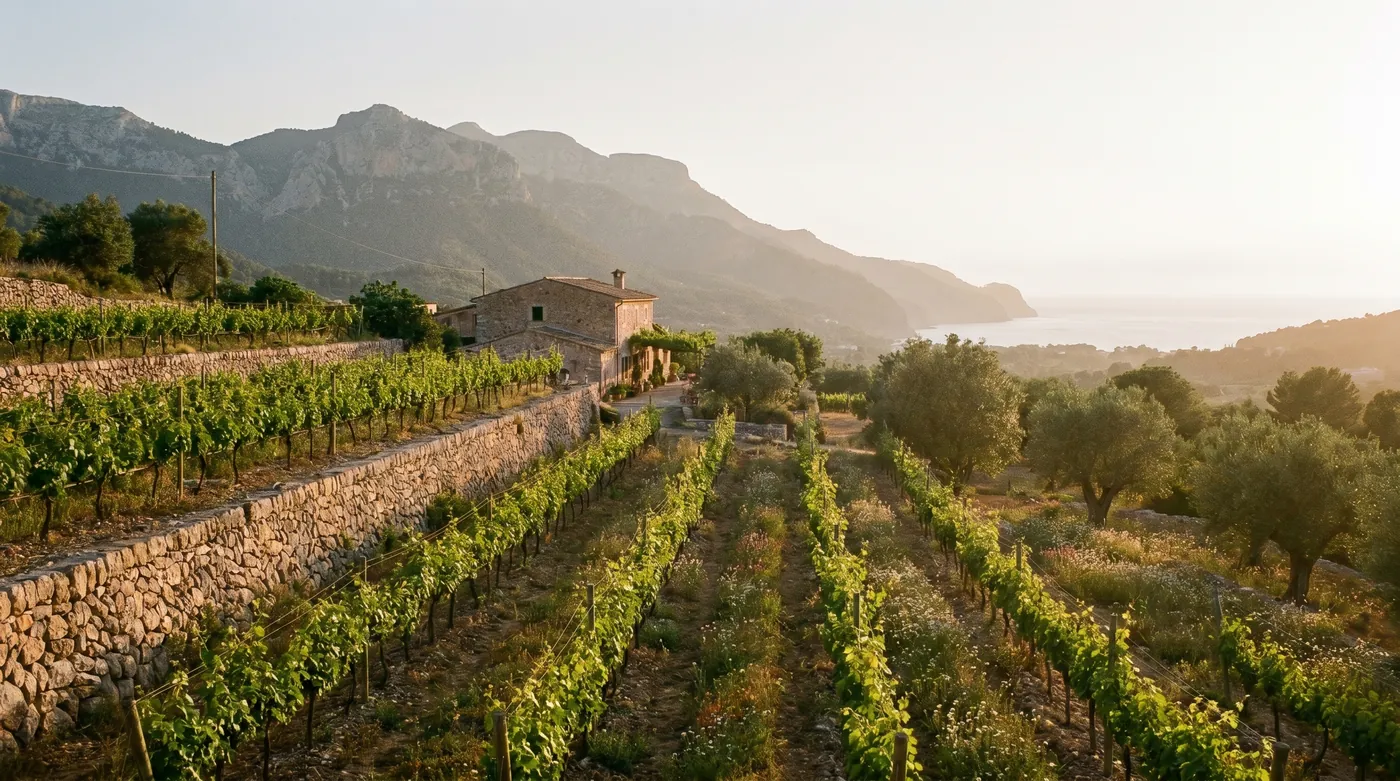
There is a Mallorca that lives quietly behind the postcard. Beyond the crowded coves and the resort strips, the island reveals itself slowly — in terraced mountainsides built stone by stone over centuries, in vineyards worked to the rhythm of the moon, in underwater meadows that have been breathing life into the Mediterranean for thousands of years.
This is the Mallorca that rewards travellers who choose to move a little more gently. Sustainable tourism here is not a marketing label; it is a way of seeing. It means walking instead of rushing, supporting the families and farmers who keep the land alive, and leaving a place as beautiful as you found it. The reward is a far richer encounter with the island — one of texture, flavour and meaning rather than mere sightseeing.
It is also a way of travelling whose time has come. As more visitors look for authenticity over volume and seek to tread more lightly on the places they love, Mallorca is quietly becoming one of the Mediterranean’s most rewarding destinations for those who want their holiday to mean something — to the island, and to themselves.
If you want to experience the real spirit of the island, follow its three great landscapes: the mountains, the countryside and the sea. Here are the three sustainable experiences we believe every conscious traveller should have in Mallorca.
1. Walk the Serra de Tramuntana on the Dry Stone Route
Running like a spine along Mallorca’s north-western edge, the Serra de Tramuntana is the island’s wild and beating heart. Limestone peaks rise more than 1,400 metres above a jade-green sea, pine forests give way to silver olive groves, and timeless villages such as Valldemossa, Deià and Sóller seem to belong to another, gentler century.
In 2011 the Serra de Tramuntana was declared a UNESCO World Heritage Site — not only for its natural beauty but as a cultural landscape, a place transformed over centuries by human hands working in harmony with a difficult terrain. Generations of Mallorcans carved the steep slopes into farmable terraces, built irrigation channels, and laid winding paths, all using a single, remarkable craft: dry stone, where rock is stacked without mortar into walls, steps, wells and snow houses that still stand today.
The best way to experience all of this on foot is the GR221, the Ruta de Pedra en Sec (Dry Stone Route). Stretching roughly 150 kilometres from Port d’Andratx in the south-west to Pollença in the north-east, it is the island’s most iconic long-distance trail. You do not need to be an athlete to enjoy it: the route divides into manageable daily stages, linked by villages, mountain refuges and small guesthouses, so you can walk a single afternoon section or commit to a week-long traverse, choosing your own pace. The craft that gives the trail its name is so significant that the art of dry stone walling is itself inscribed on UNESCO’s list of the Intangible Cultural Heritage of Humanity — a living tradition you are quite literally walking through.
2. Taste Biodynamic Wine at Montesión Wine Estate
From the mountains, head inland to the warm, golden plain around Porreres, where the second of our three experiences awaits — and where the idea of sustainability reaches one of its purest expressions in a glass of wine.
Porreres has lived and breathed viticulture for almost eight centuries. As early as 1229, following the conquest of King James I, licences were granted to cultivate vines here, and agriculture became the backbone of the region. That long, unbroken tradition continues today at Montesión Wine Estate, where ancient terroir meets one of the most demanding forms of agriculture in the world.
Montesión’s wines are grown organically and biodynamically under Demeter certification — the highest and most rigorous standard in sustainable viticulture. To understand why this matters, it helps to know the difference. Organic farming removes synthetic chemicals; biodynamics goes much further, treating the entire estate as a single living organism. The soil, the vines, the surrounding plants and animals, even the cycles of the moon and the seasons, are all considered part of one interconnected system. There are no synthetic fertilisers, no pesticides, no shortcuts — only patient, holistic work that strengthens the land year after year rather than depleting it. This is regenerative farming in its truest sense: agriculture that gives back to the earth.
Behind this philosophy stands a remarkable figure. The wines carry the invisible signature of Carlos Feliu of Can Feliu, Mallorca’s pioneer of biodynamic farming and the only certified Demeter farmer in the entire Balearic Islands. His decades of experience and his deep, almost intuitive understanding of the land are present in every bottle Montesión produces — wines that are elegant and full-bodied, fresh and aromatic, alive with the character of the island and recognised at international wine fairs.
The estate’s range captures the full personality of Mallorca: structured, full-bodied reds, fresh and aromatic whites, and bright, lively rosés, alongside special vintages of Cabernet Sauvignon and Syrah. Each is crafted with time-honoured methods, and some are aged in clay amphorae as well as oak — a centuries-old technique that lends the wines remarkable purity and depth. You can explore the whole collection on the Our Wines page.
For the conscious traveller, a visit to Montesión is sustainable tourism at its most delicious. You are not merely tasting wine; you are supporting a working biodynamic estate, helping to keep a centuries-old wine culture alive, and tasting the landscape itself — pure, free of synthetic chemicals, and shaped by a respect for nature that you can sense on the palate.
The estate offers a range of wine and culinary experiences designed to connect you with the land. A gentle introduction begins with the Classic Wine Tasting, three wines served with traditional Mallorcan biscuits. From there you can deepen the experience with the Wine & Olive Oil Tasting, pairing the estate’s award-winning wines with its own Demeter extra virgin olive oil, or the Mallorcan Flavours Experience, which adds pa amb oli with local cheese, sobrasada and olives. For a full gastronomic journey, the Tapas & Wine Experience travels through the island’s culinary heritage course by course.
Those with a more curious palate will love the exclusive pairings — Cabernet Sauvignon with artisanal cheeses, Syrah with fine chocolates and truffles, or a fascinating side-by-side tasting of the same wine aged in barrel versus amphora. And for an afternoon you will never forget, the signature Create Your Own Wine experience lets you feel like a winemaker for a day: tour the vineyard, taste the varieties, blend your own wine and personalise the label to take home.
It is the perfect heart to any sustainable journey through Mallorca — and a story worth lingering over. You can discover the full philosophy behind the estate on its Organic & Biodynamic page, and book your experience here.
3. Kayak and Snorkel over the Posidonia Meadows
The third landscape is the one that defines every Mediterranean island: the sea. But the most extraordinary thing about Mallorca’s waters is invisible from a sun lounger and only revealed to those who slip beneath the surface — the Posidonia oceanica meadows.
Despite appearances, Posidonia is not seaweed. It is a flowering plant, endemic to the Mediterranean, that forms vast underwater prairies swaying gently in the current. Often called the “lungs of the Mediterranean,” it produces oxygen, stores enormous quantities of carbon, shelters an astonishing diversity of marine life, and keeps the water around the Balearics famously clear and turquoise. Its presence is the single best indicator of a healthy, living sea. So precious are these meadows that the great Posidonia field between the neighbouring islands of Ibiza and Formentera is itself a UNESCO World Heritage Site.
To grasp its importance, consider the scale: Posidonia carpets an estimated 38,000 square kilometres of the Mediterranean seabed — an area roughly the size of Switzerland. It is also responsible for one of the island’s most misunderstood sights. Those fibrous brown “balls” that sometimes wash up on Mallorcan beaches are not pollution at all, but egagròpils — naturally rolled fragments of Posidonia fibre, and a reassuring sign that a healthy meadow is thriving just offshore.
Yet Posidonia is also extremely slow-growing and fragile, threatened by boat anchors, pollution and rising sea temperatures. This is exactly why experiencing it responsibly matters — and why a guided eco-tour is one of the most rewarding sustainable activities on the island.
The most beautiful place to discover it is around Sant Elm, gateway to the protected marine waters of Sa Dragonera Natural Park. Here, small-group guided kayak and snorkelling tours, often led by a marine biologist, take you paddling along an unspoiled coastline of cliffs and hidden coves, far from the crowds. You stop to snorkel directly over the seagrass meadows, watching fish, starfish and other creatures dart between the green blades while your guide explains the role this humble plant plays for the Mediterranean and the planet. The island’s quieter east-coast calas offer similar crystalline waters for those exploring that side of Mallorca.
